
Table of Contents
- How to Choose the Best Professional Services for Ceiling Water Damage Repair in South Florida
- Quick Comparison: Top Ceiling Water Damage Repair Providers in South Florida
- Ceiling Repair Cost After a Leak: What South Florida Homeowners Pay
- Water-Damaged Drywall Repair: Process, Timelines, and Critical Steps
- Mold Remediation After Water Damage: When to Call a Specialist
- Condo Water Damage Responsibility Florida: Who Pays for Ceiling Repairs?
- Conclusion
- Frequently Asked Questions
Last Updated: October 16, 2026
How to Choose the Best Professional Services for Ceiling Water Damage Repair in South Florida
Finding the best professional services for ceiling water damage repair in South Florida starts with verifying credentials, confirming written pricing, and checking that one crew can handle drying, drywall, texture, and paint.
Below, we break down exactly what to check before you hire anyone.
- Licensing and insurance: Ask for the state license number and a certificate of insurance before work begins.
- Written pricing: Get the full scope, including texture matching and paint, in writing.
- Single-crew accountability: Confirm the same team handles drywall, texture, and painting.
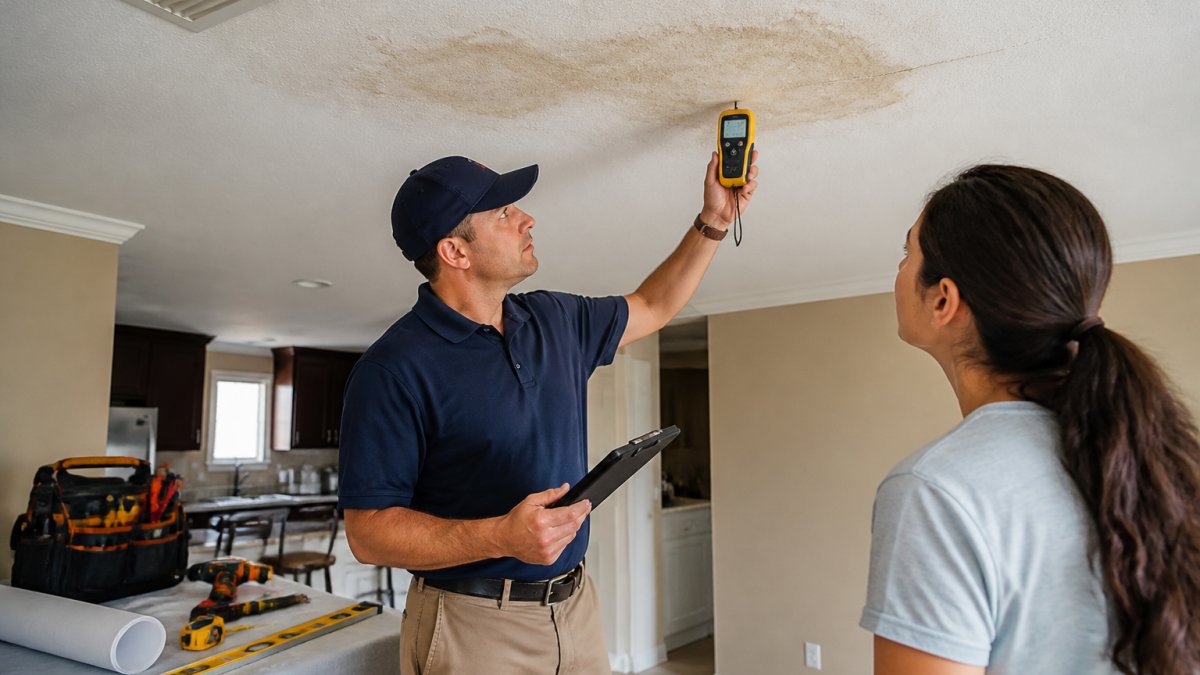
- Moisture verification: A qualified provider measures moisture rather than guessing by touch.
- Emergency availability: Water spreads fast, so ask how quickly they can respond.
The most common mistake is hiring a painter to cover a stain before the ceiling is dry. Trapped moisture keeps feeding mold and rot behind a fresh coat of paint, and the stain returns within weeks.
Quick Comparison: Top Ceiling Water Damage Repair Providers in South Florida
Most pages that rank for this query are single-company service pages or directory listings, so they never explain how providers actually differ. That is the gap this section fills. Instead of naming one winner, it gives you the categories of provider that operate in the region, what each is genuinely good at, and the vetting questions that separate a competent crew from a callback.
| Provider Type | Best For | Typical Strengths | Typical Weaknesses | What to Verify |
|---|---|---|---|---|
| Full-service repair and restoration crew | Ceiling damage that needs drying plus drywall, texture, and paint | One accountable team, documented moisture readings, finish work in-house | Higher minimum job size than a handyman | State license, general liability and workers’ comp certificates, written line-item estimate |
| Water damage restoration company | Active leaks, saturated cavities, mold concerns | Commercial drying equipment, moisture mapping, remediation protocols | Frequently subcontracts drywall, texture, and paint to a second company | Who actually performs the finish work, and whether the estimate separates drying from reconstruction |
| Licensed general contractor | Structural damage, sagging ceilings, joist or truss repair | Can pull permits and coordinate structural trades | May not own drying equipment or perform remediation | License status, permit history, whether drying is subcontracted |
| Handyman or drywall specialist | Small stains and patches with no active moisture | Lower minimums, fast scheduling for cosmetic work | Little or no drying capability, limited ability to confirm the cavity is dry | Whether they own a moisture meter and will document readings |
| Insurance-approved network contractor | Claims where the carrier directs the repair | Familiarity with adjuster documentation and carrier scope | Scope is set by the carrier, not by you | Whether you are allowed to obtain a second estimate |
How to tell them apart in a ten-minute phone call
Ask every provider the same five questions and write down the answers:
- What is your license number, and can you email a certificate of insurance today? In this state, mold remediation and certain restoration work are regulated activities, and a legitimate company will produce documentation without hesitation.
- Will you measure moisture in the ceiling cavity, or only on the surface? Surface readings alone can miss a saturated cavity above the drywall. A qualified provider uses a pin or pinless moisture meter and, when needed, a thermal camera.
- Who textures and paints, your employees or a subcontractor? This is the single biggest predictor of whether the repair blends in. Split trades produce visible seams and mismatched texture.
- Will you put the full scope in writing, including texture matching and paint, before work begins? A verbal estimate is not a scope.
- How soon can you be on site, and what do you do on day one? Water spreads, so response time matters more than a polished sales pitch.
Credentials worth checking before you sign
- State licensing. Verify the license number through the state’s online business and professional regulation lookup rather than trusting a logo on a truck.
- Insurance. Ask for a certificate of insurance showing general liability and workers’ compensation. If a worker is injured on your property and the company is uninsured, that exposure can land on you.
- Restoration certifications. Industry credentials from organizations such as the Institute of Inspection, Cleaning and Restoration Certification (IICRC) indicate formal training in water damage restoration and mold remediation. They are not a substitute for a license, but they are a useful signal.
- References and recent local jobs. Ask for two or three references from the past six months, ideally in buildings similar to yours.
- Written estimate with line items. Drying, demolition, drywall, texture, primer, and paint should each appear as separate lines.
You are not choosing the company with the best website. You are choosing the company that will measure moisture, document it, and keep the drywall, texture, and paint under one roof. Everything else is marketing.
Ceiling Repair Cost After a Leak: What South Florida Homeowners Pay
Almost no page ranking for this query publishes numbers. That is the gap this section claims. Pricing depends on the size of the damaged area, the ceiling material, the texture, whether drying or mold remediation is required, and how hard the area is to reach. For current prices, please visit HandyFixNow’s website or request a quote.
| Scope of Work | Typical Range | What Drives the Number |
|---|---|---|
| Small stain, dry cavity, patch and repaint | $250 – $600 | Patch size, whether texture must be matched, single visit |
| One-room ceiling section, drywall replacement plus texture and paint | $600 – $1,800 | Square footage, popcorn or knockdown texture, ceiling height |
| Full room ceiling replacement | $1,500 – $4,000+ | Room size, insulation replacement, light fixtures and vents to work around |
| Drying only (no reconstruction) | $500 – $2,500 | Number of air movers and dehumidifiers, number of days, cavity access |
| Mold remediation add-on | $1,000 – $6,000+ | Contaminated square footage, containment, disposal, clearance testing |
| Emergency after-hours response | Often a 25% – 50% premium over standard rates | Time of day, weekend or holiday call, urgency |
What actually moves the price
- Square footage of damage. A single stained section costs far less than a full room. Most crews price by the area they cut out and replace, not by the size of the visible stain.
- Ceiling material. Plaster repair takes longer than standard drywall because it is built up in coats and must cure between them. Older homes with plaster ceilings often cost noticeably more per square foot.
- Texture matching. A smooth ceiling is the cheapest finish to blend. Popcorn and knockdown finishes add labor because the texture has to be sprayed and feathered into the surrounding ceiling so the patch disappears.
- Moisture and mold. If the cavity is still wet, drying equipment has to run for days before reconstruction can start. If mold is present, containment, removal, and clearance add both time and cost.
- Access and height. Two-story ceilings, stairwells, and ceilings crowded with recessed lights, vents, or sprinkler heads raise labor. So does furniture that has to be moved and protected.
How to read an estimate
Ask for a line-item estimate and check that it separates:
- Moisture assessment and documentation
- Water extraction and drying (with equipment count and expected days)
- Demolition and disposal of unsalvageable material
- Drywall installation and finishing
- Texture matching
- Primer and paint
- Any mold remediation, listed separately with its own scope
If a contractor refuses to put the scope in writing, that is your answer. A verbal number is not a quote, and it is the most common way homeowners end up paying for work they did not agree to.
Be cautious of any quote that bundles drying and reconstruction into a single lump sum with no equipment count or day estimate. You cannot tell whether drying was actually performed, and you have no basis to dispute the charge if the ceiling fails again.
Water-Damaged Drywall Repair: Process, Timelines, and Critical Steps
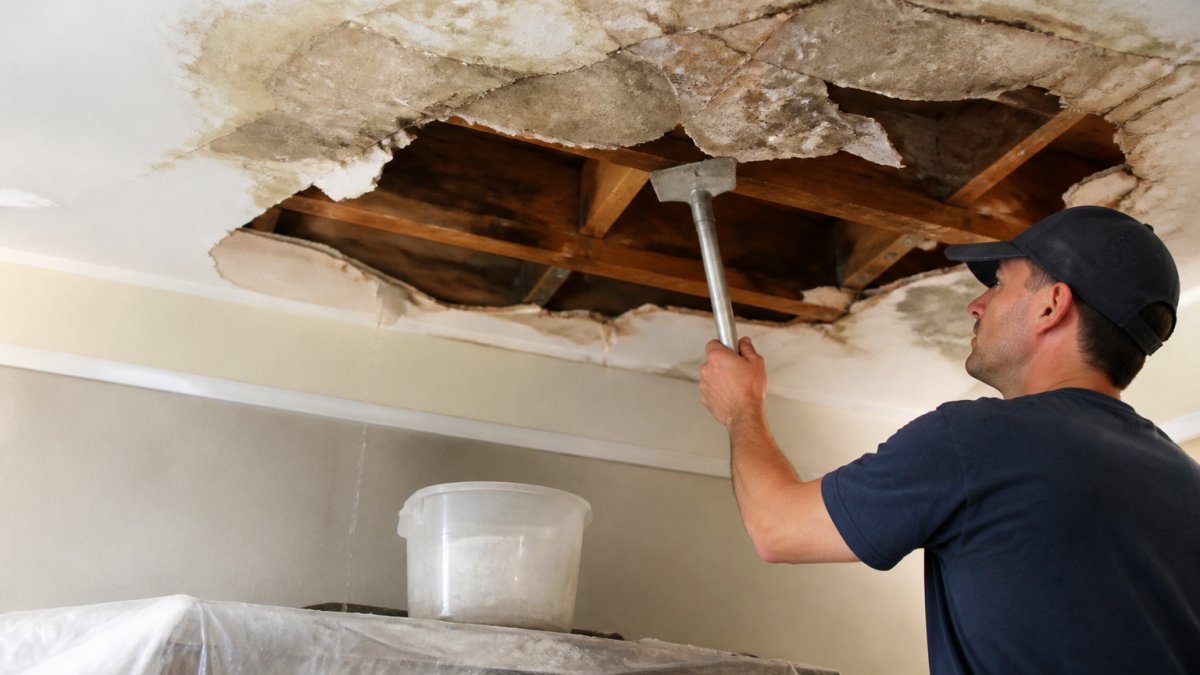
Water-damaged drywall repair moves through a fixed sequence: stop the leak, dry the cavity, remove unsalvageable material, replace it, then texture and paint. According to FEMA guidance on flood-damaged buildings, wet building materials must be dried and inspected before reconstruction, because hidden moisture damages the structure behind finished surfaces.
Here is the sequence we follow on every ceiling job:
- Locate the source. Find and stop the leak before any repair.
- Assess moisture. Measure the ceiling and the cavity above it.
- Extract and dry. Remove standing water and run drying equipment.
- Remove damaged material. Cut out drywall that has lost its strength.
- Replace and seal. Install new drywall and seal the joints.
- Match texture. Blend the finish into the surrounding ceiling.
- Prime and paint. Finish the ceiling so the repair disappears.
Timelines vary.
Mold Remediation After Water Damage: When to Call a Specialist
Mold remediation after water damage becomes necessary when moisture has been present long enough for mold to grow, which in a warm, humid climate can happen faster than most homeowners expect. According to EPA guidance on mold cleanup in homes, mold growth typically requires a moisture source, and the underlying water problem must be fixed before cleanup, or the mold returns.
Call a specialist when you notice:
- A persistent musty odor in the room
- Visible dark or greenish growth on the ceiling
- Peeling paint or bubbling texture
- Allergy-like symptoms that ease when you leave the room
- Any history of a slow, unnoticed leak
For small areas on hard surfaces, cleaning may be enough. For larger growth or mold inside the ceiling cavity, professional remediation protects both the structure and the people living there.
Snap dated photos of the stain and the moisture readings before any repair starts. Insurers ask for them, and once the ceiling is patched, the evidence is gone.
Condo Water Damage Responsibility Florida: Who Pays for Ceiling Repairs?
Condo water damage responsibility in Florida usually depends on where the leak originated and what the governing documents say. In most Florida condominium buildings, the association is responsible for common elements such as the roof, exterior walls, and structural slabs, while unit owners are responsible for the interior of their own unit. The dividing line is defined by Florida Statutes Chapter 718 on condominiums and by the building’s declaration.
In practice, that means:
- A leak from the roof or a common pipe is often the association’s responsibility.
- A leak from a neighbor’s unit is typically that owner’s responsibility.
- Repainting and repairing the inside of your ceiling is often the owner’s cost.
Document everything, notify the association in writing immediately, and keep a record of every communication. If the association delays, that paper trail matters.
Conclusion
Ceiling water damage gets worse the longer it sits, and the repair only holds if the moisture is gone before the drywall goes back up. HandyFixNow handles the entire job with one accountable crew, from moisture assessment and drywall replacement through texture matching and painting, so you are not coordinating multiple trades. We provide written pricing before work begins and free estimates with no obligation to book.
Frequently Asked Questions
How to repair ceiling drywall from water damage?
First, stop the water source and dry the area completely. Remove any sagging or crumbling drywall, treat for mold if needed, then install new drywall, tape, and apply texture to match. Finally, prime and paint the entire ceiling for a seamless finish. Professionals use moisture meters to confirm dryness before closing up the ceiling.
Who is responsible for water damage in a condo in Florida?
In Florida, responsibility depends on the source and your condo association’s governing documents. If the leak originates from a common element or another unit, the association or that unit’s owner may be liable. Damage inside your unit is often your responsibility to repair. Review your declaration and consult a property attorney for specific guidance.
How much does it cost to repair a ceiling after a leak?
Ceiling repair costs vary based on the extent of damage, ceiling height, and whether mold remediation is needed. For current pricing, please visit HandyFixNow’s website or request a quote. Get written estimates from multiple licensed contractors before work begins.
Should I call a water damage restoration company or a drywall contractor?
If the ceiling is still wet or has active moisture, call a water damage restoration company first to extract water and dry the structure. Once dry, a drywall contractor can handle repairs, texture, and painting. Some full-service providers, like HandyFixNow, offer both services under one crew, simplifying coordination.
Leave a Reply