
Last Updated: November 1, 2026
Quick Summary
Professional interior painting cost depends on scope, surface condition, and materials, so there is no single price. Published guides put it at roughly $2 to $6 per square foot, with a national average near $4,220 for a typical interior project. Compare bids line by line to confirm they cover the same surfaces.
- Per-square-foot rates vary by source, and a national average for an interior project is about $4,220.
- Ask whether a per-square-foot quote measures floor area or wall area, since wall area is usually two to three times larger.
- Trim, doors, and cabinets take more time per square foot than flat walls and are often priced separately.
- Hourly painter labor typically runs $25 to $75 per hour, with $35 to $50 the most common range.
- Get an on-site measurement or photo package, because published ranges cannot account for your walls.
Table of Contents
- Typical Professional Interior Painting Prices
- Interior Painting Cost Per Square Foot Explained
- What Drives Your Interior Painting Estimate
- Professional Painter Labor Cost and Hourly Rates
- How Much It Costs to Paint a Room
- How to Compare Painting Estimates Line by Line
- Requesting Your Free Estimate From HandyFixNow
- Frequently Asked Questions
Typical Professional Interior Painting Prices
Most homeowners who ask what professional interior painting costs want a number they can budget around. The honest answer is that the price depends on scope, surface condition, and materials.
HandyFixNow provides written pricing before work begins, so you can review the terms before any work starts.
Published national guides offer useful reference points, but they are not quotes for your home. CertaPro Painters interior painting cost guide reports a national average of about $4,220 for an interior project, while NerdWallet home painting cost guide lists interior painting at $2 to $6 per square foot. Treat these as benchmarks, not promises.
Use these benchmarks to sanity-check a bid. If one quote is far below the others, ask what surfaces, preparation, and coats it includes.
Interior Painting Cost Per Square Foot Explained
Cost per square foot is the most common way painters price interior work, and it is the number most worth understanding before you compare bids. The rate is built from three inputs: the surface area to be painted, the labor hours that area requires, and the materials consumed. Painters multiply the area by a rate that bundles those three so the customer sees one clean figure.
Published ranges vary by source and scope. A New Leaf Painting cost estimator lists professional interior work at about $2.25 to $4.00 per square foot, assuming premium materials and two coats. Improovy interior painting cost guide reports an average near $3.75 per square foot. NerdWallet home painting cost guide puts interior painting at $2 to $6 per square foot. The spread is wide because each source defines “square foot” differently.
What the Square Footage Actually Measures
This is the single biggest source of confusion in per-square-foot pricing. A painter may quote against any of these:
- Floor area. The square footage of the room as listed on a floor plan. A 12-by-12 bedroom is 144 square feet of floor, but roughly 384 square feet of wall (perimeter times ceiling height, minus doors and windows).
- Wall area. The actual paintable wall surface. This is the fairest measure for walls-only work, and it is usually two to three times the floor area.
- Full scope area. Walls plus ceilings plus trim plus doors, each measured and priced at its own rate.
Ask which measure the rate applies to. A “$3 per square foot” quote on floor area is a very different number from “$3 per square foot” on wall area.
A Worked Example
Consider a 12-by-12-foot bedroom with 8-foot ceilings, one standard door, and two windows. Its paintable wall area is calculated by multiplying the perimeter by the ceiling height and subtracting openings. Because per-square-foot rates vary by source, ask each painter to state which measure and rate they are using. If a per-square-foot quote and a per-room quote for the same room land far apart, one of them is measuring something different.
Why Trim, Ceilings, and Doors Cost More Per Square Foot
Flat walls are the fastest surface to paint. Trim, baseboards, doors, and window casings take more time per square foot because of cutting in, taping, sanding between coats, and brushwork. Painters often price these separately from walls, either at a higher rate or as flat line items per door or per linear foot of trim.
When a painter quotes per square foot, ask three questions: Is this floor area or wall area? Does it include ceilings and trim? How many coats does it assume? The answers tell you whether two bids are actually comparable.
How the Rate Shifts With Conditions
Rates generally depend on conditions such as ceiling height, wall repair, color changes, and number of coats. Rates change when those conditions differ:
- Ceiling height above 8 feet adds ladder or scaffold time and slows every pass.
- Heavy patching, sanding, or priming adds labor that is not in a flat per-square-foot rate.
- Dark-to-light color changes often require an extra coat or a tinted primer.
A per-square-foot rate is a starting point, not a final price. The most reliable number comes from an on-site measurement of your actual wall area and surface condition.
The table below summarises the published per-square-foot ranges and what each measure covers, so you can check which basis a quote uses.
| Source | Rate per square foot | Note |
|---|---|---|
| A New Leaf Painting | $2.25 to $4.00 | Premium materials, two coats |
| Improovy | About $3.75 | Average figure |
| NerdWallet | $2 to $6 | Each source defines square foot differently |
| Floor area | Room footprint | Common but understates wall work |
| Wall area | Two to three times floor area | Fairest measure for walls-only work |
| Full scope area | Walls, ceilings, trim, doors | Each item priced at its own rate |
What Drives Your Interior Painting Estimate
Several factors move a painting estimate up or down. Our interior painting services cover walls, ceilings, trim, doors and cabinets, with patching, sanding and finishing included in the scope.
- Room size and ceiling height. Taller walls take more time and more material.
- Surface condition. Patching, sanding, and priming old or damaged walls add labor.
- Number of coats. Two coats is standard for a finished look. Some colors need three.
If you plan to add drywall repair or a texture match, ask for it as a separate line. Pricing for exterior painting and maintenance across South Florida is quoted separately from interior work.
Professional Painter Labor Cost and Hourly Rates
Some painters quote by the hour or the day rather than by the project. Carolina Renew house painting cost guide lists professional painter labor at $25 to $75 per hour, with $35 to $50 per hour as the most common range.
Hourly pricing can be fair, but it puts more of the risk on you. Ask for a time estimate, a cap on total hours, and a clear explanation of what happens if the job takes longer.
Labor is often a significant part of the bill, and materials cost depends on the paint you choose.
How Much It Costs to Paint a Room
Per-room pricing is what most homeowners want to know, and it is also where published averages are least reliable. Facade Colorizer interior painting guide lists bedroom painting at $650 to $1,400 and notes that a whole home can run $5,000 or more. Those figures are useful as a sanity check, but the same bedroom can legitimately cost $500 or $2,000 depending on scope and condition.
Typical Per-Room Ranges by Scope
Room pricing generally follows three scope levels:
- Walls only, good condition, two coats. Typically the least expensive scope.
- Walls plus ceiling, standard trim. Adds ceiling area and cut-in time.
- Full room: walls, ceiling, trim, doors, and closet interior. Usually the most expensive scope, because trim and doors take more time per square foot.
Larger rooms, high ceilings, heavy repairs, and dark-to-light color changes push any of these higher. A room in good condition with standard 8-foot ceilings and light colors sits at the low end.
Why Two Bids for the Same Room Differ
When two quotes for the same bedroom come back $600 apart, the gap is almost always scope, not price. One bid may cover walls only; the other may include ceiling, trim, two doors, patching, and primer. Before you compare totals, compare what each bid actually includes. The line-by-line comparison section below walks through the specific items to check.
How to Get an Accurate Room Quote
Published ranges cannot account for your walls. To turn a range into a real number, give each painter the same information so their bids are comparable:
- Measure the room. Note length, width, and ceiling height. Multiply perimeter by ceiling height to estimate wall area, then subtract doors and windows.
- Photograph the surfaces. Take wide shots and close-ups of cracks, stains, peeling paint, and any patched areas. Photos let painters price repairs without a second visit.
- List the scope explicitly. Walls only, or walls plus ceiling, trim, doors, and closet? Write it down and send the same list to every painter.
- State the paint and finish. Name the brand and line if you have a preference, and specify sheen (matte, eggshell, satin, semi-gloss). Sheen affects both price and durability.
- Disclose the condition. Mention any known repairs, texture matching, or moisture issues. Hidden problems are the most common reason a final bill exceeds the estimate.
- Ask what the quote excludes. Furniture moving, minor drywall repair, primer, and paint supply are common exclusions. Knowing them up front prevents surprises.
The most accurate room quote comes from an on-site visit or a detailed photo-and-measurement package. A phone estimate based on room count alone is a ballpark, not a price.
Questions to Ask Before You Accept a Room Quote
- How many coats are included, and is primer separate?
- Is the ceiling included, and at what rate?
- Are doors, trim, and closets priced per item or per linear foot?
A painter who answers these in writing is giving you a quote you can compare. A painter who answers vaguely is giving you a starting point for a negotiation you would rather not have after the job begins.
How to Compare Painting Estimates Line by Line
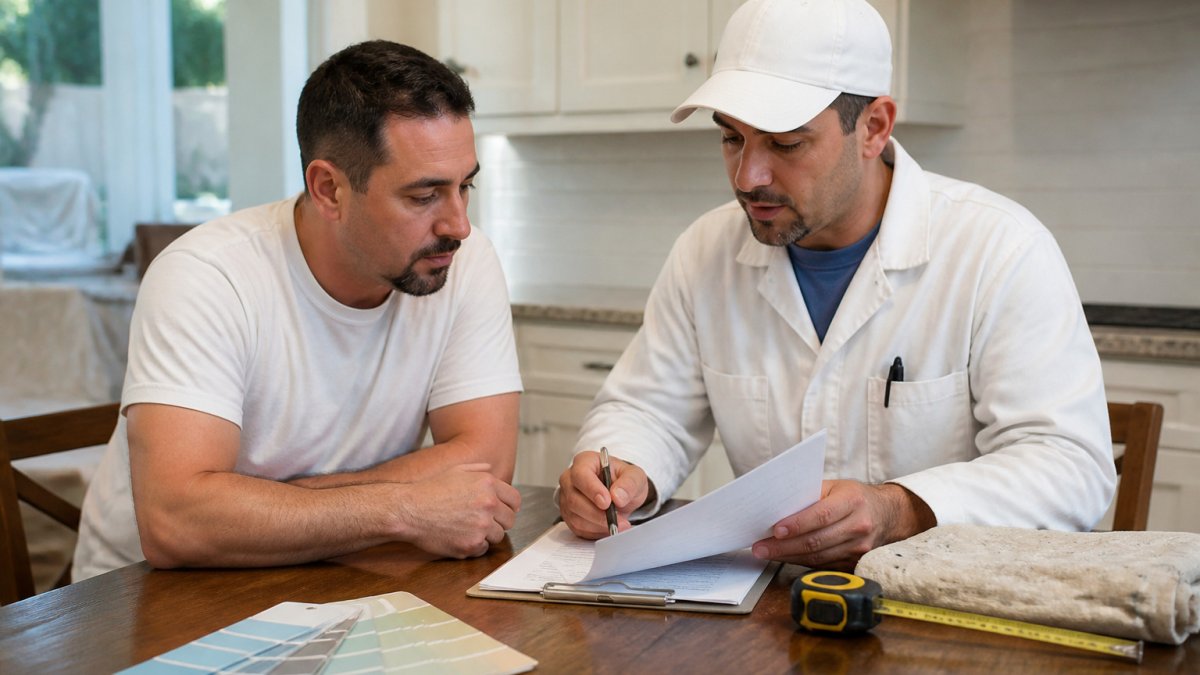
Two bids for the same room can look far apart. Usually the difference is in scope, not in price. Compare them line by line:
- Surfaces included. Does each bid cover walls only, or walls, ceilings, trim, and doors?
- Preparation. Look for patching, sanding, caulking, and priming. Vague wording like “prep as needed” is a warning sign.
- Number of coats. Confirm each bid specifies coats, not just “paint.”
- Paint brand and grade. Ask for the exact product name and line.
- Protection and cleanup. Floors, furniture, and debris removal should be listed.
- Warranty and timeline. Note what is guaranteed and how long the job will take.
A clear written quote should cover these points in plain English. If a bid cannot be compared line by line, ask the painter to rewrite it.
Requesting Your Free Estimate From HandyFixNow
HandyFixNow provides free estimates with no obligation to book. One accountable crew handles the job from start to finish, so drywall repair, texture matching, and painting are handled together rather than split across separate trades.
HandyFixNow provides written pricing before work begins and commits to clean, protected job sites. To request your estimate, use the contact page or call 561-663-4233. You can also request a free estimate online.
Frequently Asked Questions
How much can I charge for interior painting just labor?
Labor is usually priced by the hour or as a share of the total project, and rates depend on the painter’s experience, the number of coats, and how much prep work is involved. Ask any painter to break the bid into labor and materials so you can see what the labor component actually covers. Compare the labor figure against the scope on the written estimate, since a low labor number can hide prep work that is billed elsewhere or skipped entirely. Pricing varies by market and job, so request written quotes from several professionals before deciding.
How much is a professional painter per day?
Daily rates depend on crew size, the complexity of the job, and local labor rates, so there is no single figure that applies to every project. Many quotes are built from estimated labor hours rather than a flat daily fee, which makes it easier to compare bids. When you request an estimate, ask how many days the crew expects to work, how many people will be on site, and what happens if the job takes longer than planned. Those answers reveal more than the daily rate alone.
What should an interior painting quote include?
A complete interior painting quote should list the rooms or surfaces included, such as walls, ceilings, trim, baseboards, and doors, along with the number of coats and the paint quality. It should also describe surface preparation, including patching, sanding, and primer, plus furniture protection, floor covering, and cleanup. Look for a payment schedule and a clear statement of what happens if hidden damage is found. Written pricing before work begins is the best protection against surprise charges on the final invoice.

Leave a Reply